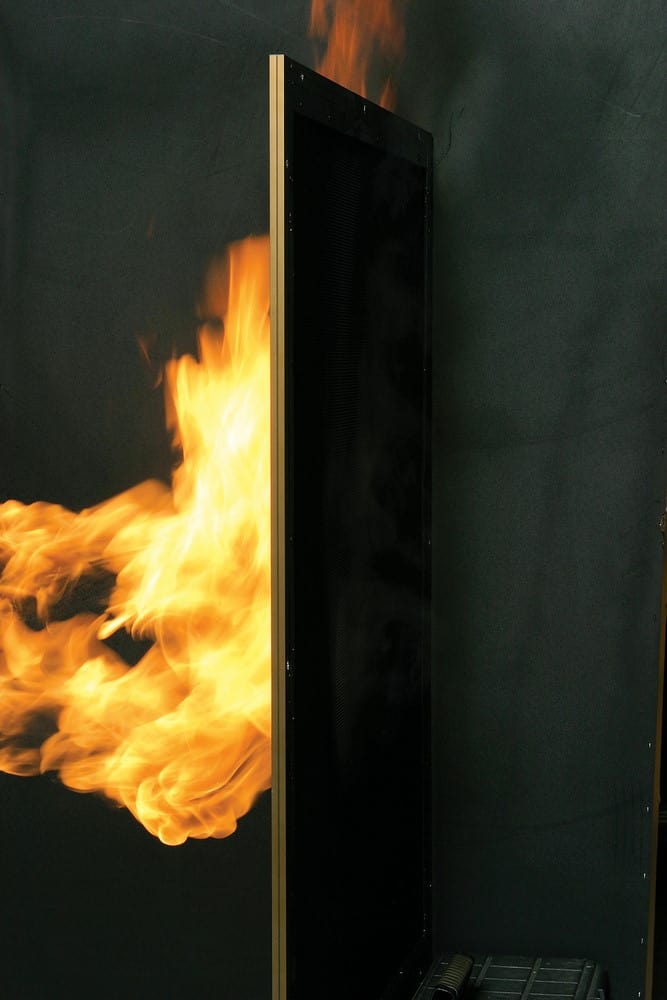
Crimsafe security screens deliver two independently tested thermal performance benefits alongside their AS 5039 security rating: a fire attenuation rating of 45% radiant heat flux reduction and a solar shading benefit of up to 53% reduction in heat entering through screened openings. For Darwin homeowners, both figures carry direct practical relevance. Properties in bushfire-prone areas around Palmerston, Humpty Doo, and Berry Springs need to understand what this means for BAL-rated construction. And in Darwin’s extreme solar radiation environment, cutting solar heat gain through windows by more than half has a measurable effect on air conditioning loads and energy costs across the whole year.
What Crimsafe Fire Attenuation Means for Darwin Properties
The 45% fire attenuation figure comes from independent testing of Crimsafe’s stainless steel mesh under controlled radiant heat exposure conditions. It means 45% of the radiant heat flux from a fire source on the other side of the screen does not pass through to the interior. This is a documented product characteristic, not a general estimate.
For Darwin properties with BAL ratings from BAL-12.5 upwards, this performance data is relevant to your building certifier’s assessment. It is not a standalone BAL compliance rating. Whether a specific Crimsafe installation satisfies the opening requirements for your particular BAL zone must be confirmed under the NT Government Building Advisory Services guidelines at
Northern Territory Building and Development Requirements. DABSCO can supply Crimsafe product data sheets to support that process on request.
The fire attenuation characteristic comes directly from the density and structure of Crimsafe’s 304 grade Tensile-Tuff stainless steel mesh, locked into the aluminium frame with a patented screw-clamp at 125mm intervals. The same system that resists knife and tool attacks also intercepts and disperses radiant heat energy. This is why this performance is specific to Crimsafe and not present in standard aluminium grille screens or basic flyscreen mesh.
Shading Coefficient and Energy Costs in Darwin’s Climate
Darwin sits in Climate Zone 1 under the NCC, one of the highest solar radiation environments in Australia. During the build-up from October through to the start of the wet season, north and west-facing unshaded windows absorb substantial solar heat, and air conditioning runs hard to compensate. Crimsafe’s shading benefit of up to 53% means solar heat entering through screened openings is cut by more than half compared to unscreened glass.
For NCC Section J energy efficiency compliance and NatHERS thermal performance assessments, the glazing shading coefficient is a calculated input. A security screen with a verified shading coefficient can improve the modelled energy performance of a Darwin home without relying on tinted glass or external louvre shading structures. The Australian Building Codes Board publishes current NCC energy requirements, including the Section J provisions for Climate Zone 1 buildings, through its online portal at
National Construction Code (NCC) Section J Energy Efficiency Requirements.
The WERS (Window Energy Rating Scheme) rates window and screen products for energy performance across Australian climate zones. For new builds or substantial renovations in Darwin, providing your NatHERS assessor with Crimsafe’s documented shading data supports more accurate thermal performance modelling for screened glazing openings. Current product ratings are searchable through the
Window Energy Rating Scheme (WERS) Product Database.
How Crimsafe Compares to Other Screen Types on Thermal Performance
Standard aluminium grille screens and basic stainless mesh products do not carry independently tested and published fire attenuation or solar shading data. Crimsafe’s performance figures are the product of controlled testing, not general claims. This distinction matters when you are making compliance decisions for BAL-rated construction or preparing NCC Section J glazing calculations for a Darwin build.
Security Screen Thermal Performance Comparison
| Screen Type | Fire Attenuation | Solar Heat Reduction | AS 5039 Rated |
| Crimsafe Tensile-Tuff | 45% radiant heat flux | Up to 53% | Yes |
| Standard stainless mesh | No independent test data | Partial, unquantified | Varies |
| Aluminium 007 grille | Not applicable | Minimal | Varies |
Fire attenuation and shading data specific to Crimsafe Tensile-Tuff mesh. Consult product data sheets for individual product comparisons.
UV Protection and Interior Preservation in Darwin Homes
Darwin’s dry season brings low sun angles and intense UV radiation through west and north-facing windows for months at a stretch. This is a real maintenance problem for Darwin homeowners: flooring, furnishings, and window coverings exposed to direct sun degrade faster than in southern climates. Crimsafe’s 53% solar heat reduction also reduces the UV and infrared load entering through screened openings, slowing that degradation without requiring reflective glass or blockout blinds. For rental properties across Darwin and Palmerston, this extends the working life of interior fittings between tenancies and reduces maintenance turnover costs over time.
Installation Standards That Protect Performance
DABSCO installs Crimsafe to AS 5039 (the product standard for security screen doors and window grilles) and AS 5040 (the installation standard). Test methodology for security screen products falls under AS 5041. Correct installation matters for both security performance and thermal performance. A frame with gaps around the perimeter reduces the effective shading area and undermines the product’s AS 5039 rating. DABSCO fabricates Crimsafe frames at our Winnellie factory and sizes them precisely to each opening so both performance characteristics are fully retained.
Where Fire Attenuation and Shading Benefits Apply Across the Crimsafe Range
The fire attenuation and shading coefficient performance applies wherever Crimsafe Tensile-Tuff mesh is installed. Fixed
Crimsafe window security screens across north and west-facing openings deliver the full solar shading benefit consistently throughout the year.
Crimsafe security doors at entry and exit points carry the same tested thermal characteristics. Properties fitted with
Crimsafe cyclone debris screens over larger openings also gain the attenuation and shading performance across those panels.
Frequently Asked Questions
What is Crimsafe’s fire attenuation rating?
Independent testing shows Crimsafe mesh reduces radiant heat flux by 45%. This means 45% of the radiant heat from a fire source on the other side of the screen does not transfer through to the interior.
How much solar heat does Crimsafe block in a Darwin home?
Crimsafe reduces solar heat entering through screened openings by up to 53%. This cuts air conditioning loads and improves interior comfort during Darwin’s build-up and throughout the dry season.
Does Crimsafe meet BAL requirements in the Northern Territory?
Crimsafe has tested fire attenuation performance, but BAL compliance for a specific opening must be confirmed with a building certifier using NT Government Building Advisory Services guidelines. DABSCO can supply product data sheets to support that assessment.
Can Crimsafe’s shading data help with NCC Section J compliance in Darwin?
Yes. The documented shading coefficient can be used as an input in NatHERS assessments and Section J glazing calculations for Climate Zone 1 buildings in Darwin. Product ratings are searchable at
WERSLink, Window Energy Rating System.
What mesh gives Crimsafe its thermal performance?
Crimsafe uses 304 grade Tensile-Tuff stainless steel mesh locked into the aluminium frame with a patented screw-clamp at 125mm intervals. The density and structure of this mesh produce both the security and thermal performance characteristics.
Is DABSCO a licensed Crimsafe installer in Darwin?
Yes. DABSCO at 19 Swan Crescent, Winnellie, is a licensed Crimsafe installer and has operated from the same Darwin location since 1966. All Crimsafe products are fabricated locally to AS 5039 and AS 5040 standards.